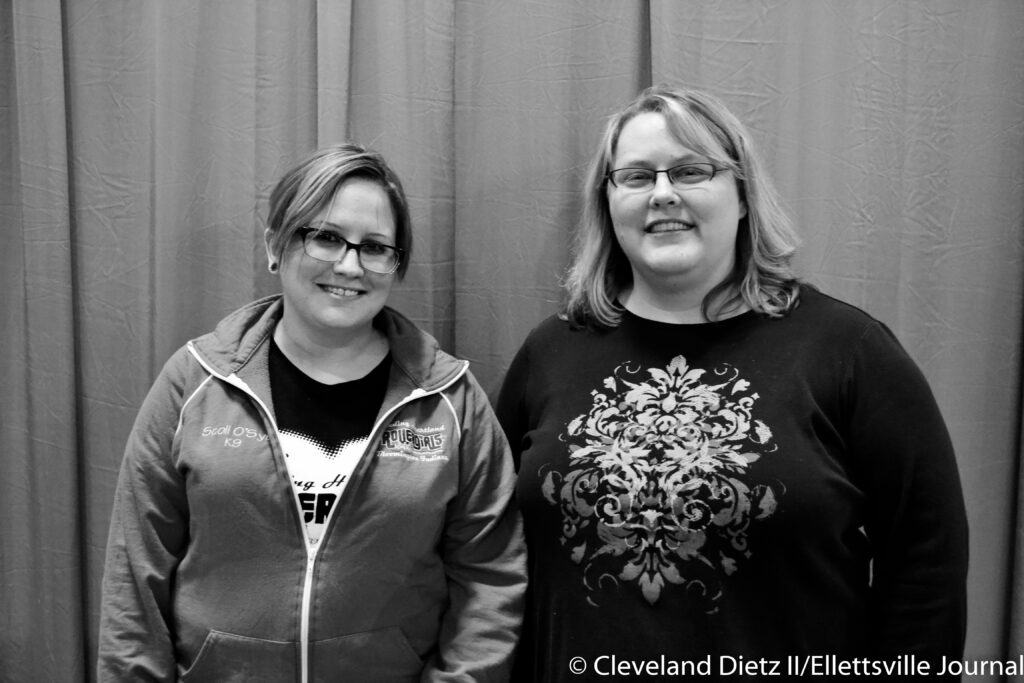
When Ellettsville resident Meghan Mayhugh joined the sport, she did so as someone doctors told would never walk again.
They gave her the prognosis after a back surgery to repair her scoliosis, an abnormally curved spine.
She remembered that when she joined Bloomington’s Bleeding Heartland Rollergirls in 2007. It was one more physical sport in a series of them.
“If I can get hurt and break a limb, I’m going to try it,” Mayhugh said.
Like most in roller derby, Mayhugh chose to skate using an alias – Scoli O’sys.
“I used to be so ashamed of my scoliosis. I have a big scar on my back. I didn’t want anybody to see it,” Mayhugh said. “Now, I’m like, ‘who cares? I made it.'”
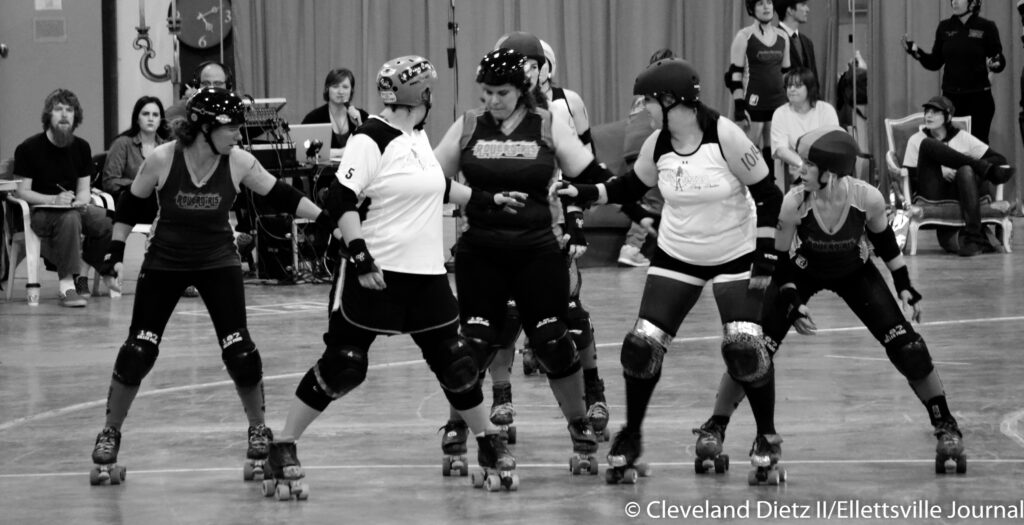
The sport began in the 1930s, but today’s “bouts” use unified rules set by an international governing body formed in 2006, the Women’s Flat Track Derby Association.
Bouts are played on an oval track in two-minute cycles called jams for 30-minute halves.
Each team fields five players – four blockers and a jammer.
One point is scored for each member of the opposing team the jammer laps twice during a jam. Another point is gained for each opponent the jammer passes until the jam’s conclusion. The blockers try to keep the jammer from scoring.
“It used to be a different kind of roller derby – my grandma enjoyed this – where it was the banked track, brawling,” said Anna Bednarski, Ellettsville resident and non-skating official for the Rollergirls. “It was more of a show, more of a no-holds-barred kind of thing.”
“Real injuries were what (the audience) wanted to see,” Mayhugh added.
Mayhugh was forced to quit competing due to an injury.
She became a zebra, or referee, to keep participating.
Then, in 2011, during a game against Knoxville, Tennessee, a Bloomington player hit a Knoxville player and both collided into Mayhugh.
“My ankle stayed and the rest of my body went,” she said.
The accident snapped her ankle and destroyed the soft tissue around it.
Today, she has a titanium plate in her leg and a surgical boot on her ankle. She carries a cane wrapped in zebra-striped tape. Her ankle will never heal.
“I am now forbidden to wear high heels,” said Mayhugh, who is 4-foot-11. She joked she could not find most of her right shoes anyway.
Now she serves as evaluation coordinator for non-skating officials, a role that helps Bleeding Heartland Rollergirls’ volunteer staff meet the certification standards set by the association.
Mayhugh said the job is appealing because she cannot get hurt, but she can stay involved.
Bednarski, whose derby name is Annie Stetic, got involved when a coworker invited her to volunteer.
“At first, I was doing things like standing outside of the track and keeping track of penalties,” Bednarski said. “Now I can keep track of the score and the lineup. Now I’m starting to learn things about the penalty box.”
She stressed that being part of the association requires a lot of documentation. The breadth of knowledge required for certification and rule execution makes the non-skating official’s job hard. But it was necessary to stay involved with the association.
Bednarski got into skating because of roller derby.
“I can’t skate very well, but seeing these ladies do this, you get the bug,” she said.
Mayhugh agreed. The game was infectious. It was hard to stay so close without skating.
“I miss it. I really miss it,” she said.
The Bleeding Heartland Rollergirls’ next home bout will be against the Grand Raggidy Roller Girls in the Cardiac Arena at the corner of Vernal Pike and Curry Pike April 13 at 6 p.m.
Originally published in Ellettsville Journal, 2013. Republished here for archival and portfolio purposes.