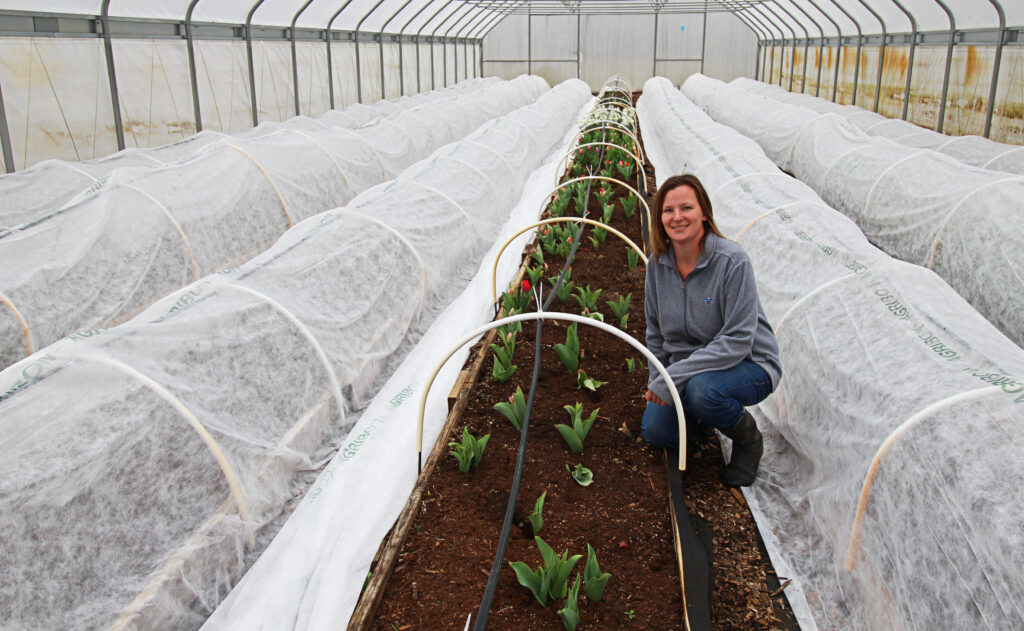
Sara Creech had just moved to a 43-acre property in North Salem when she packed her things into her car and drove 574 miles to Fayetteville, Arkansas.
She was going to attend a week-long educational event for military veterans interested in small-scale sustainable farming careers called Armed to Farm. Most of the people in attendance were like Creech—people who’d been out of the military for a few years exploring what they might do with the next chapter of their lives.
“It was like this camaraderie that we immediately had,” said Creech, who was a surgical nurse in the Air Force. “It was fun to hear everybody’s dreams about farming, their dreams about raising animals or raising vegetables. There was just something really powerful about it.”
They learned about business planning, budgeting, marketing and all the things it took to start and operate a successful enterprise. They also visited area farms to see what it took to do it.
The dream wasn’t new to her.
Creech and her husband, an Air Force pilot, cultivated it during his struggle with colon cancer. It started as a look into other therapies he could do when surgery and chemotherapy didn’t work. That led them to pay attention to how nutrition affected their health. They started going to cooking classes and learning about organics. Soon, their life revolved around food.
After doctors in Florida told them there was nothing else they could do for him, Creech and her husband moved to Texas for further treatment.
They started visiting farms while they were in Texas. They read books and watched movies about farming. They talked about starting a farm together when he retired from the Air Force a few years down the road.
After nine months of treatment in Texas, Creech’s husband passed away.
She moved back to Florida and tried to go back to working as a nurse, but couldn’t concentrate and made mistakes. After quitting, she spent six months in mourning. She pulled up the grass in the small front yard at her house to plant a garden. She said it was the only time she’s been able to grow blueberries.
Her sister called and asked her what she was going to do with her life. Creech said she wanted to move into the middle of nowhere and start a farm. Her sister said she and her family were thinking of moving onto a farm, too. They made plans to do it together.
Creech bought the property in North Salem. Her sister’s family moved in and quickly moved out because they learned they didn’t want to live in the middle of nowhere.
Creech kept the dream alive.
She spent six months working on the house and the land, which were in poor condition after being left vacant for a long time.
“I went to work one day, and I came home, and there were like four refrigerators that had been dumped at the back of the farm because everybody thinks it’s totally abandoned,” Creech said.
She cleaned up the woods and removed invasive plants. She planted 50 fruit trees and a couple of hundred raspberry bushes. She went to the Armed to Farm event.
When she got back from Arkansas, Creech knew she wanted to start a farm and she wanted to reach out to veterans. She contacted the local Natural Resources Conservation Service representative, Jared Chew, and he helped her work out a plan for Blue Yonder Organic Farm.
She regained control of a 16-acre piece of her land that had been leased to someone farming corn and soybeans. The soil in that area was damaged by conventional farming methods. She planted a combination of grasses and pollinator and grazing plants there. These were cover crops—plants that germinate quickly and cover the ground—to get nutrients and organic matter back into the soil. They also suppress weeds and keep them from establishing themselves. Creech’s cover crop of choice is buckwheat.
She applied for and received a hoop house so she could keep chickens. She started with five. Now she has 600 egg-layers, and during meat chicken season, the total number of birds rises above 1,000. She has several hoop houses now, each covered with recycled billboards, one advertising a Prince concert.
There’s an acre to 1.5 acres of vegetables, 20 sheep and 200 logs of shiitake mushrooms. Creech keeps a number of ducks and will soon begin raising cattle. Two dogs, Athena and Tank, guard the livestock.
Creech’s ideal farm mimics nature, so she has worked to get as close to that goal as she can.
She began using the meat bird pens to help fertilize crops naturally. Butchered animals, along with the bedding used for baby chicks, go into compost and the compost goes back on the soil. It feeds the microflora in the soil, brings new microflora into the soil, and produces heartier plants.
“I really like to have things that complement each other and use things we have on the farm,” Creech said.
Along with opening Blue Yonder Organic Farm, Creech started a nonprofit arm called Operation Groundwork, which receives the profits from the farm.
The nonprofit is a veteran training program that began in 2015. Once a year, the farm hosts a week-long training event similar to the one Creech went to in Arkansas—a combination of business and visiting different farms in and within two hours of Indianapolis.
On the first Sunday of every month during spring, summer and fall, the farm hosts a picnic for military veterans and their families.
“We just want people to start connecting with nature and seeing that having animals or growing food—it just nourishes a part of you, especially in the military that can easily get hidden away,” Creech said. “Responsibility for caring for animals, caring for vegetables, it’s a reason to get up every day.”
Proof In The Soil
More than 10 years ago, a researcher noticed there was something different about the soil at M & J Starkey Farms in Brownsburg.
Bob Barr, a research scientist at the Center for Earth and Environmental Sciences at Indiana University-Purdue University Indianapolis, asked to take some soil samples. That led to an ongoing water-monitoring project. It is one of two in which the farm is involved.
Three years after taking over his dad’s farm in 1986, Mike Starkey and his nephew, Jeff, began to change things on the 2,550-acre farm. Starkey said the changes came out of economic stress. Farming equipment and fuel were getting more expensive, while corn market values stagnated.
Mike and Jeff started no-till soybeans in 1989 and, from 1999 forward, did no-till corn. They began planting cover crops between harvests. Starkey said those changes saved money and, over time, increased yields. The techniques also produced the soil that caught Barr’s attention.
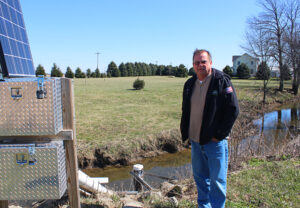
Researchers began monitoring the water coming off Starkey’s farm for another long-term project two years ago. They also put sensors in the creek that passes through the farm. The creek feeds into the School Branch, a tributary of Eagle Creek Reservoir. A machine attached to the sensors produces real-time water quality reports 24/7 that can be accessed on the internet.
The water coming off the farm, Starkey said, was cleaner than the creek because of the soil.
“You can’t put a value on the soil health we have in our soil,” he said.
Originally published in Hendricks County ICON, 2017. Republished here for archival and portfolio purposes.